TOEFL托福試題與解題示範教學
最新真題:2026 年 10 月 21 日
The Accidental Discovery of Teflon
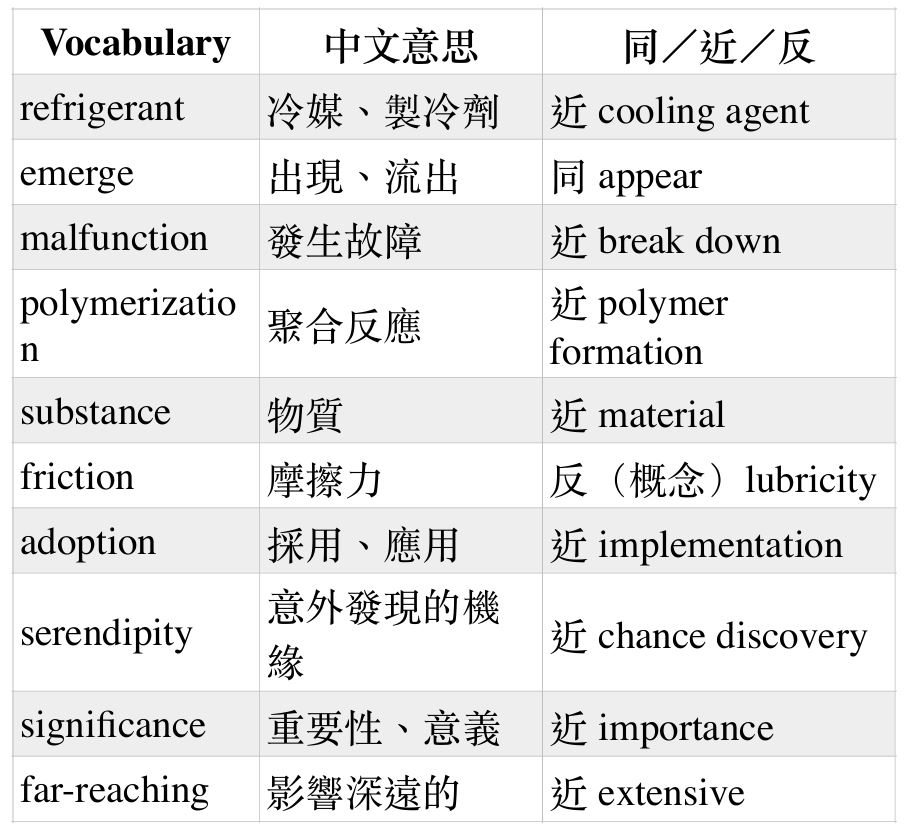
In 1938, American chemist Roy Plunkett was developing a new refrigerant when an unexpected observation redirected his research. A cylinder containing tetrafluoroethylene (TFE) gas appeared empty because no gas emerged when its valve was opened. Yet the cylinder still weighed nearly as much as before. Rather than assuming that the equipment had malfunctioned, Plunkett and his assistant examined its contents. They discovered a waxy white powder formed when TFE molecules had unexpectedly joined into long chains, a process known as polymerization.
The resulting substance, polytetrafluoroethylene (PTFE), possessed an unusual combination of properties. It resisted chemical reactions, tolerated relatively high temperatures, and exhibited exceptionally low friction. These characteristics eventually made PTFE valuable in industrial seals, electrical insulation, medical devices, and nonstick cookware. Its widespread adoption, however, required further research because the new polymer was initially difficult and expensive to manufacture. Its later commercial success would reshape several manufacturing industries.
Plunkett's discovery illustrates the role of serendipity in science, but it also challenges the idea that breakthroughs arise from luck alone. The transformation of the gas was accidental; recognizing the powder's significance was not. Careful observation, chemical expertise, and subsequent experimentation turned an apparent laboratory failure into a material with far-reaching applications.
1. What is the passage mainly about?
A. The gradual replacement of traditional refrigerants by PTFE.
B. How an unexpected chemical reaction led to the discovery of a commercially valuable material.
C. The environmental consequences of manufacturing synthetic polymers.
D. Why modern industries have abandoned conventional plastic materials.
2. Why did Plunkett decide to investigate the gas cylinder?
A. He suspected that the cylinder contained a dangerous chemical.
B. The cylinder had become unusually hot during the experiment.
C. The cylinder retained its weight even though no gas could be released.
D. He had already predicted that TFE would form a solid polymer.
Ans: BC